Table of Contents
Are Peptides Legal in Canada? Short Answer
If you are wondering whether peptides are legal in Canada, the answer depends on the specific compound and its intended use. This guide explains the regulatory landscape so researchers can confidently determine if peptides are legal in Canada for their work.
Yes — research peptides are legal to purchase, possess, and sell in Canada when labeled and sold for research use only (RUO) and not marketed for human therapeutic use. The nuance is in what qualifies as RUO and how products must be labeled.
Are Peptides Legal in Canada Under Current Regulations?
Canada regulates peptides under the Food and Drugs Act (R.S.C. 1985, c. F-27) and the Food and Drug Regulations. The critical principle is that classification hinges on intended use, not molecular identity. A peptide’s legal status depends on how it is marketed, labeled, and represented — not on the molecule itself. Health Canada distinguishes:
- Therapeutic products — sold with health claims, requiring a Drug Identification Number (DIN) and full market authorization after safety and efficacy review.
- Research chemicals — sold without health claims, labeled RUO, not marketed for human or veterinary use.
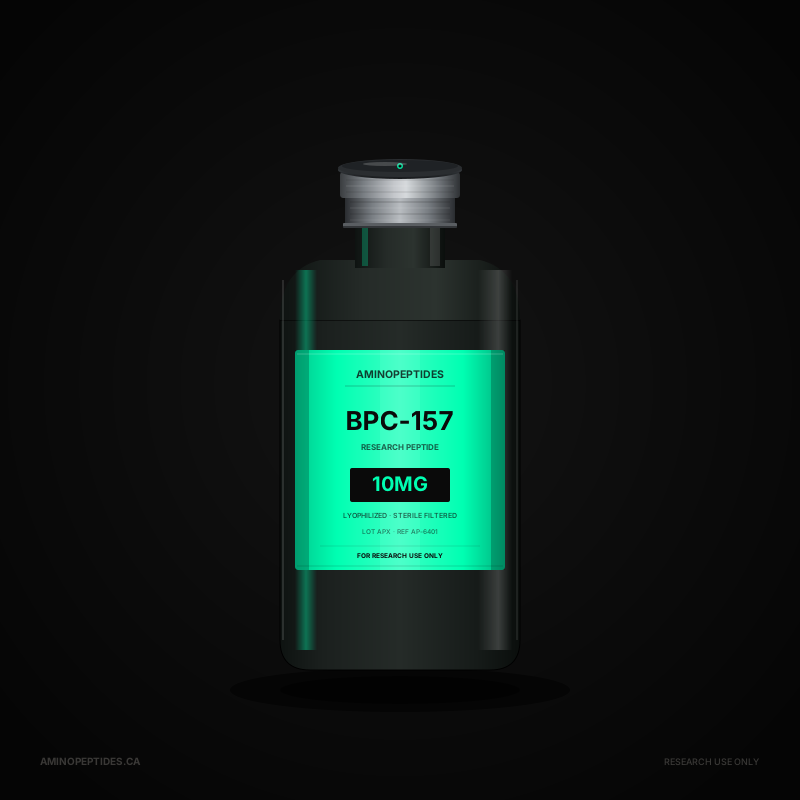
Aminopeptides peptides fall in the second category. They are sold strictly for laboratory research and carry no therapeutic claims.
What “Research Use Only Means in Practice
The RUO designation is a commercial and legal disclaimer, not a formal regulatory category registered with Health Canada. Its function is to make clear that the product has not undergone Health Canada review for safety or efficacy and is not intended for human administration. Practically, this means:
- Products cannot be marketed with dosing claims, “before and after” photos, or health outcomes.
- Products cannot be promoted for weight loss, muscle gain, or any human use.
- Buyers are expected to use the compounds for legitimate research — in vitro assays, animal models, or analytical reference standards.
- The vendor is not selling a drug, and the buyer assumes responsibility for lawful use within their jurisdiction.
Courts and regulators would look at the totality of circumstances — marketing language, packaging, customer base, and sales context — to determine whether the RUO label is genuine or a pretext for selling unauthorized drugs. Vendors who maintain strict RUO compliance in all marketing and labeling operate within the law.
The Controlled Drugs and Substances Act (CDSA)
To fully answer whether peptides are legal in Canada, we must examine the CDSA, which governs which substances are restricted.
The Controlled Drugs and Substances Act (S.C. 1996, c. 19) schedules specific substances across Schedules I through IX. Most research peptides — including BPC-157, TB-500, CJC-1295, ipamorelin, semaglutide, tirzepatide, and epithalon — are not scheduled under the CDSA.
However, researchers should be aware that growth hormone itself is a prescription drug in Canada, and certain peptide hormones or their close analogs could fall under regulatory scrutiny if they are analogs of scheduled substances. Synthetic insulin analogs are prescription-controlled. Researchers should check the current CDSA schedules for specific compounds before purchasing.
Federal vs Provincial Jurisdiction
Drug scheduling, border control, and the Food and Drugs Act are federal matters. A researcher in Ontario operates under the same federal import rules as one in British Columbia or Quebec. However, provinces regulate pharmacy practice, professional licensing, and workplace safety (including laboratory standards under occupational health legislation). This means that while the legality of purchasing research peptides is uniform across Canada, provincial occupational health regulations may impose additional documentation or safety requirements for laboratory use.
Customs and Import
International buyers also want to know: are peptides legal in Canada when imported from abroad? Canadian-sourced peptides avoid most import complications.
Domestic Canadian vendors eliminate customs issues entirely. For international shipments, the Canada Border Services Agency (CBSA) can hold peptide shipments if:
- The product is labeled or suspected to be for human therapeutic use without a DIN.
- The substance is scheduled under the CDSA.
- Customs declarations are incomplete, misleading, or list ambiguous end-use.
- The shipment arrives in consumer-style packaging or bulk quantities that suggest commercial distribution rather than research use.
Peptides shipped with clear RUO labeling, proper customs declarations, and commercial invoices stating research purpose generally clear CBSA without issues. Buying from a Canadian supplier like Aminopeptides removes cross-border risk entirely — no customs holds, no import duties, and delivery in 1–3 business days to most provinces.
Are Peptides Legal in Canada vs Other Countries?
| Country | Regulatory Body | Research Peptide Stance |
|---|---|---|
| Canada | Health Canada | Legal when sold RUO with no therapeutic claims. Most peptides unscheduled. |
| United States | FDA | Similar framework. Recent enforcement increase against vendors making therapeutic claims (2024–2025 warning letters to compounding pharmacies). |
| United Kingdom | MHRA | Peptides not licensed as medicines cannot be sold for human use; research supply is permitted under similar RUO principles. |
| Australia | TGA | Strictest among the four. Many peptides are Schedule 4 (prescription-only). Active prosecution of personal importation (2023–2024 enforcement actions against BPC-157 and others). |
Canada sits in a moderate position — less restrictive than Australia, roughly comparable to the US and UK for research-use sales.
Controlled vs Uncontrolled Peptides
The answer to are peptides legal in Canada depends heavily on whether a specific peptide appears on a controlled substances schedule.
Most research peptides (BPC-157, TB-500, semaglutide, tirzepatide, epithalon, and similar) are uncontrolled in Canada. A small number of growth-hormone-releasing peptides and insulin analogs face tighter scrutiny. When in doubt, consult the Government of Canada site or a regulatory lawyer.
Documentation and Lab Requirements
When confirming that peptides are legal in Canada for your research, proper documentation strengthens your compliance position.
Canada has no mandatory federal license to purchase research peptides. However, institutional purchasers (universities, private laboratories) typically maintain:
- Purchase records and chain-of-custody documentation.
- Safety Data Sheets (SDS) under WHMIS 2015/GHS for workplace compliance.
- Internal ethics board approvals for animal studies or other regulated protocols.
- Proper storage and handling documentation consistent with laboratory best practices.
Individual researchers purchasing for independent study should maintain basic records of purchase, storage conditions, and intended use for their own compliance protection.
What to Look for in a Canadian Supplier
Now that you understand peptides are legal in Canada for research purposes, choosing a reputable supplier is the next step.
- HPLC or mass-spec purity report for every batch (≥ 99% minimum, ≥ 99.9% preferred).
- Cold-chain fulfillment and proper RUO labeling on every product.
- Canadian warehousing — no cross-border customs exposure.
- Clear RUO disclaimer on every product page.
- Batch-specific Certificates of Analysis available on request.
See About Aminopeptides for our QC and labeling standards.
Recent Developments on Whether Peptides Are Legal in Canada (2024–2026)
Health Canada has increased scrutiny of online peptide vendors who use marketing language implying human therapeutic use. Several Canadian-based websites received compliance letters in 2024–2025 for marketing peptides with language suggesting human consumption or health benefits. The global trend toward tighter regulation of compounded semaglutide and tirzepatide has spilled into broader peptide oversight, but no new CDSA scheduling of common research peptides has occurred as of early 2026.
Vendors who maintain strict RUO labeling, avoid health claims, and sell only to legitimate research purchasers continue to operate within the established legal framework.
Frequently Asked Questions
Are peptides legal in Canada for personal research? Yes, most synthetic research peptides are legal to purchase in Canada for laboratory and research purposes.
Are peptides legal in Canada to import? Canadian-sourced peptides avoid customs complications. Importing from outside Canada may trigger additional scrutiny depending on the compound.
Are peptides legal in Canada without a prescription? Research-grade peptides sold for laboratory use do not require a prescription. However, peptides marketed for human therapeutic use fall under Health Canada regulations.
Important Disclaimer
While this guide addresses whether peptides are legal in Canada, it does not constitute legal advice.
Aminopeptides peptides are sold for laboratory research use only. They are not drugs, supplements, or medical devices, and are not intended to diagnose, treat, cure, or prevent any disease. Buyers are responsible for using products in accordance with all applicable federal, provincial, and institutional regulations. Nothing on this page constitutes legal advice — consult a qualified regulatory lawyer for situation-specific guidance.