Peptide Reconstitution Calculator & Dosage Tool
This free peptide reconstitution calculator helps you determine exactly how many units to draw on your insulin syringe. Enter your vial size, water volume, and desired dose — get instant results with a visual syringe guide.
Need help choosing the right peptide? Our full guided calculator walks you through goal selection, peptide matching, reconstitution, and scheduling — all in one tool.
Try the Full Peptide Calculator →How to Use This Peptide Reconstitution Calculator
Reconstituting peptides can seem intimidating if you're new to research peptides. This calculator removes the guesswork by converting your vial size, bacteriostatic water volume, and desired dose into the exact number of insulin syringe units to draw. Here's how to use it in three simple steps:
Step 1 — Select your syringe. Insulin syringes come in three common sizes: 0.3 mL (30 units), 0.5 mL (50 units), and 1.0 mL (100 units). The 0.3 mL syringe offers the finest graduation marks for precise low-volume doses. If you're unsure, 0.5 mL is the most popular choice for subcutaneous peptide injections.
Step 2 — Enter your vial & water. Select the peptide quantity printed on your vial label (e.g. 5 mg, 10 mg) and how much bacteriostatic water (BAC water) you plan to add. More water means a more dilute solution — easier to measure small doses, but requiring larger injection volumes.
Step 3 — Choose your dose. Enter the dose in micrograms (mcg) or milligrams (mg). The calculator instantly shows how many units to pull on your syringe, plus a visual guide so you know exactly where to stop.
Peptide Reconstitution Calculator Formula Explained
Volume per Dose = Desired Dose (mg) ÷ Concentration (mg/mL)
Units to Draw = Volume per Dose (mL) × 100
Insulin syringes are graduated in "units" where 100 units = 1 mL. This is why the final step multiplies by 100. For example, if you have a 5 mg vial reconstituted with 2 mL of BAC water and you want a 250 mcg (0.25 mg) dose:
Volume = 0.25 mg ÷ 2.5 mg/mL = 0.1 mL
Units = 0.1 mL × 100 = 10 units
Peptide Reconstitution: Step-by-Step Guide
What You'll Need
- Lyophilized (freeze-dried) peptide vial
- Bacteriostatic water (BAC water) — preserved with 0.9% benzyl alcohol
- Alcohol swabs for sterilizing vial stoppers
- Insulin syringe (U-100) — 0.3 mL, 0.5 mL, or 1.0 mL
- A separate syringe or needle for drawing BAC water
Reconstitution Steps
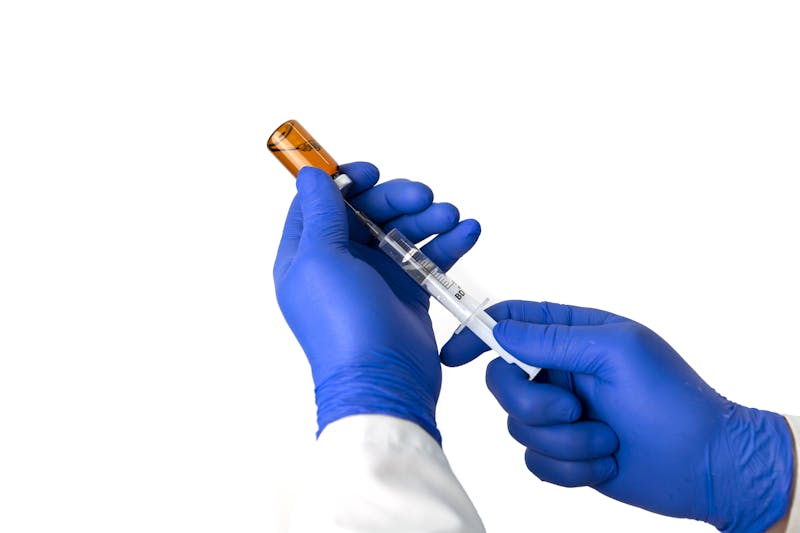
1. Clean both vial stoppers with an alcohol swab and let them air dry for 10–15 seconds.
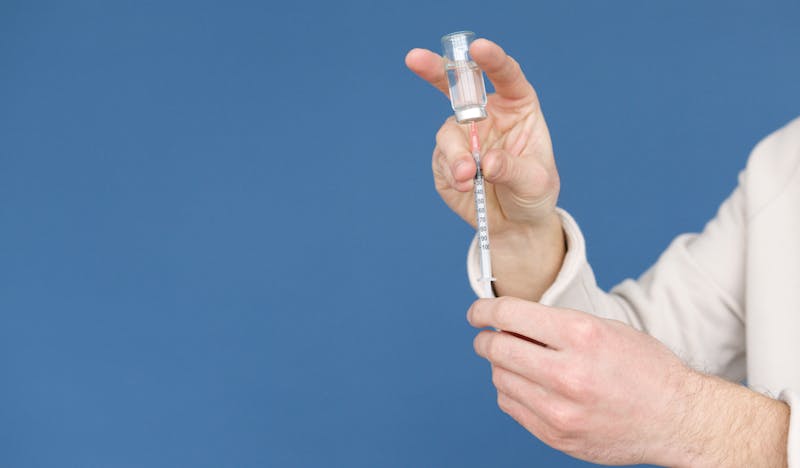
2. Draw bacteriostatic water using a syringe. The amount you add determines your concentration — use the calculator above to decide how much water to use.
3. Inject water gently into the peptide vial. Aim the stream along the inside wall of the vial — never spray directly onto the powder, as this can damage the peptide structure.
4. Swirl gently — do not shake. Tilt the vial at a slight angle and roll it between your palms until the powder fully dissolves. Most peptides dissolve within 30–60 seconds.
5. Store properly. Reconstituted peptides should be refrigerated at 2–8 °C (36–46 °F). Most reconstituted peptides remain stable for 28–30 days when stored correctly.
Common Peptide Reconstitution Calculator Mistakes to Avoid
- Shaking the vial — vigorous agitation can denature the peptide and reduce potency
- Using sterile water instead of BAC water — BAC water contains a preservative that prevents bacterial growth for multi-dose vials
- Spraying water directly on the powder — always aim along the vial wall to avoid damaging the peptide
- Leaving reconstituted peptides at room temperature — always refrigerate after mixing
- Reusing syringes — always use a fresh, sterile syringe for each injection
Understanding Insulin Syringe Units
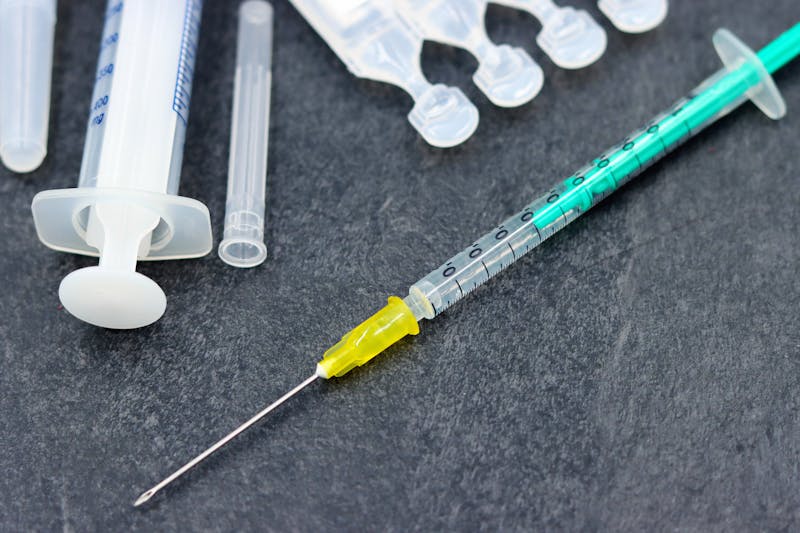
Peptide users almost universally use U-100 insulin syringes for subcutaneous injections. These syringes are calibrated so that 100 units equals exactly 1 mL. The three common sizes differ in total capacity and graduation precision:
- 0.3 mL (30 unit) syringe — finest markings, each tick = 0.5 units. Best for doses under 15 units where precision matters most.
- 0.5 mL (50 unit) syringe — each tick = 1 unit. The most versatile choice for typical peptide doses.
- 1.0 mL (100 unit) syringe — each tick = 2 units. Useful for larger volume injections or when using dilute reconstitutions.
For detailed chemical data on common research peptides, visit PubChem, the open chemistry database maintained by the National Institutes of Health. Our peptide reconstitution calculator uses standard formulas consistent with published laboratory protocols.