Sleep
Lead
The sleep category is intentionally focused. Only two peptides have a substantial peer-reviewed literature specifically on sleep architecture and circadian regulation: DSIP (delta sleep-inducing peptide) and Epitalon. Both ship lyophilized from a Canadian fulfillment facility with a matching Certificate of Analysis. Researchers use this category to model slow-wave sleep induction, REM distribution, circadian-axis regulation, and the overlap between pineal bioregulation and sleep quality. Because the category is small, this page doubles as a deep-literature overview rather than a broad survey.
Mechanism Overview
Sleep is regulated by the interplay of circadian drive (suprachiasmatic nucleus, melatonin secretion from the pineal gland) and homeostatic sleep pressure (adenosine, GABA-ergic tone, thalamocortical oscillations). The two peptides in this category intervene at different nodes.
DSIP (delta sleep-inducing peptide, Trp-Ala-Gly-Gly-Asp-Ala-Ser-Gly-Glu) was first isolated in 1977 by Schoenenberger and Monnier from the cerebral venous blood of electrically induced sleep-state rabbits. The name refers to its ability to promote EEG delta-wave activity — the signature of slow-wave (Stage N3) sleep. Published studies describe modulation of somatostatin, corticotropin, and GH release alongside direct effects on sleep architecture. Its small size and amphipathic profile allow blood-brain-barrier penetration without active transport.
Epitalon (Ala-Glu-Asp-Gly) is a Khavinson-school tetrapeptide bioregulator hypothesized to restore age-related decline in pineal melatonin secretion. Khavinson’s group has published on Epitalon’s effects on circadian melatonin-rhythm amplitude, particularly in aged-rodent and elderly-human populations. By potentially restoring nocturnal melatonin peaks, Epitalon is studied as an upstream intervention on the circadian system itself — distinct from DSIP, which acts more on homeostatic slow-wave drive.
Together the two peptides allow researchers to model both arms of the two-process sleep regulation framework (Borbély, 1982).
Featured Products
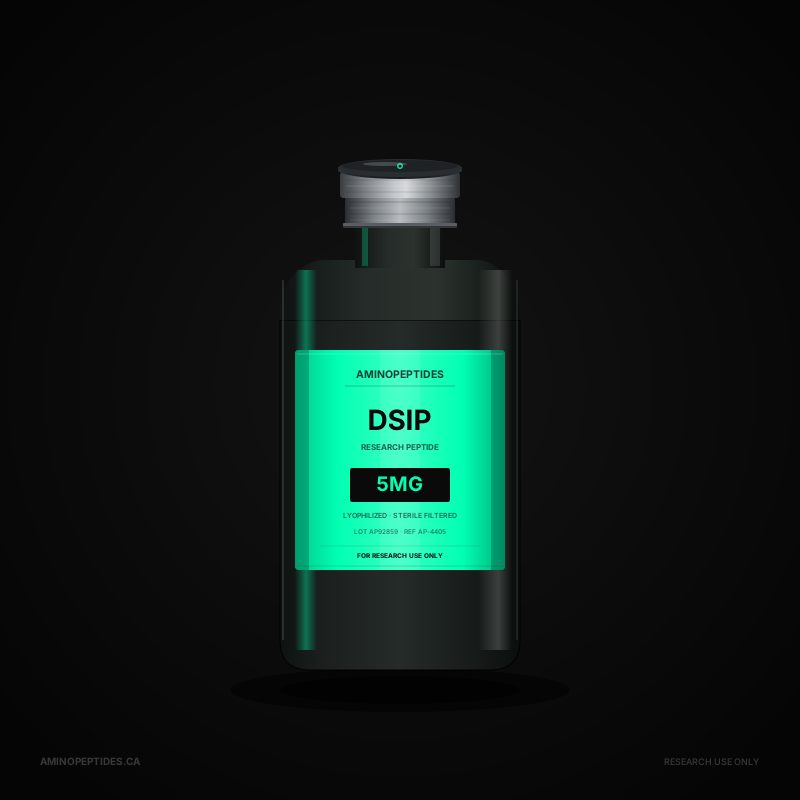
DSIP (5 mg) — Nine-residue amphipathic peptide studied for delta-wave EEG induction, slow-wave-sleep promotion, and HPA-axis modulation. Typical reconstitution is 5 mg in 2.5 mL bacteriostatic water.
Epitalon (10 mg / 50 mg) — Tetrapeptide bioregulator from the Khavinson school, studied for pineal-axis restoration, melatonin-rhythm amplitude, and age-related circadian decline. Commonly used in pulsed research protocols (10 days on / 20 days off) based on the original Russian literature.
Research Applications
Investigators working in this category explore questions such as: does DSIP administration produce measurable increases in EEG delta-wave power during the first third of the sleep cycle; how does DSIP compare with GABA-receptor modulators on total slow-wave-sleep duration; does Epitalon restore nocturnal melatonin peak amplitude in aged-rodent models; what is the interaction between pulsed Epitalon exposure and pineal gene-expression profiles; and does combined DSIP + Epitalon administration produce additive effects on sleep-quality endpoints compared with either alone. The category is also used for circadian-disruption work — jet-lag models, shift-work simulations, and aging-related advanced-sleep-phase research.
Safety & Handling
Reconstitute DSIP and Epitalon with bacteriostatic water (0.9% benzyl alcohol) using sterile technique. After reconstitution, refrigerate at 2–8 °C and use within 28 days. Lyophilized vials stored at –20 °C remain stable for 24+ months. Both peptides are light-stable but should be kept in amber vials as standard practice. Sterile syringes should be used per draw; never reintroduce a used needle into the stock vial. Both compounds are sold for in-vitro and laboratory research only and are not intended for human or veterinary use.
FAQ
Is DSIP the same as melatonin? No. Melatonin is an indoleamine secreted by the pineal gland that signals biological night. DSIP is a nine-residue peptide that promotes slow-wave sleep via different mechanisms — the two are complementary rather than interchangeable in research models.
Why is Epitalon classified as a sleep peptide when it’s also in anti-aging? Epitalon’s hypothesized mechanism — restoring pineal melatonin secretion — bridges both categories. Pineal decline contributes to both age-related sleep fragmentation and broader circadian dysregulation, so it appears in both category listings.
Does DSIP cause drowsiness like sedatives? Research literature describes DSIP as modulating sleep architecture rather than causing sedation per se. In EEG studies it increases delta-wave power without flattening REM cycles, which differs from benzodiazepine-class compounds.
How is Epitalon typically dosed in published research protocols? The classic Khavinson protocol is a pulsed 10-day cycle, repeated quarterly or semi-annually. Reconstituted solution is typically used at 5–10 mg per cycle-day in published work.
Can DSIP and Epitalon be used together in research? Yes — they target different nodes (homeostatic vs. circadian), and no adverse pharmacological interaction is described in the published literature.
Do you ship sleep peptides across Canada? Yes — DSIP and Epitalon ship tracked from within Canada, typically arriving in 2–5 business days with cold-pack protection during warm months.
Is there overlap between DSIP’s sleep effects and HPA-axis modulation? Yes — the original Schoenenberger/Monnier studies and subsequent Russian work describe DSIP’s effects on ACTH and corticotropin signalling alongside its slow-wave-sleep induction. Stress-axis regulation and sleep architecture are tightly coupled, so this overlap is expected mechanistically.
Compliance
For laboratory research purposes only — not for human consumption. Not approved by Health Canada for therapeutic use.
Internal Links Plan
- /products/dsip-5mg → product page
- /products/epitalon-10mg → product page
- /products/epitalon-50mg → product page
- /categories/anti-aging-peptides → cross-category (Epitalon overlap)
- /categories/cognitive-peptides → cross-category (DSIP overlap)
- /category/learning-hub/peptide-reconstitution-guide → learning hub
- /category/learning-hub/khavinson-bioregulator-protocols → learning hub
- /category/learning-hub/two-process-sleep-model → learning hub
Showing the single result