Table of Contents
How This Longevity Peptides List Was Built
Longevity peptides represent one of the fastest-growing areas of anti-aging research. This evidence-based ranking of the top 10 longevity peptides evaluates each compound on published preclinical and clinical data, mechanism of action, and availability for Canadian researchers.
Each peptide below was ranked by three factors: quality of human data, replication in animal models, and mechanistic clarity. Peptides with only in-vitro data were excluded. Where clinical evidence is limited, mechanistic strength and breadth of preclinical replication were weighted more heavily. This ranking reflects the state of published evidence as of early 2026.
1. Epithalon (AEDG Tetrapeptide) — Top Longevity Peptide
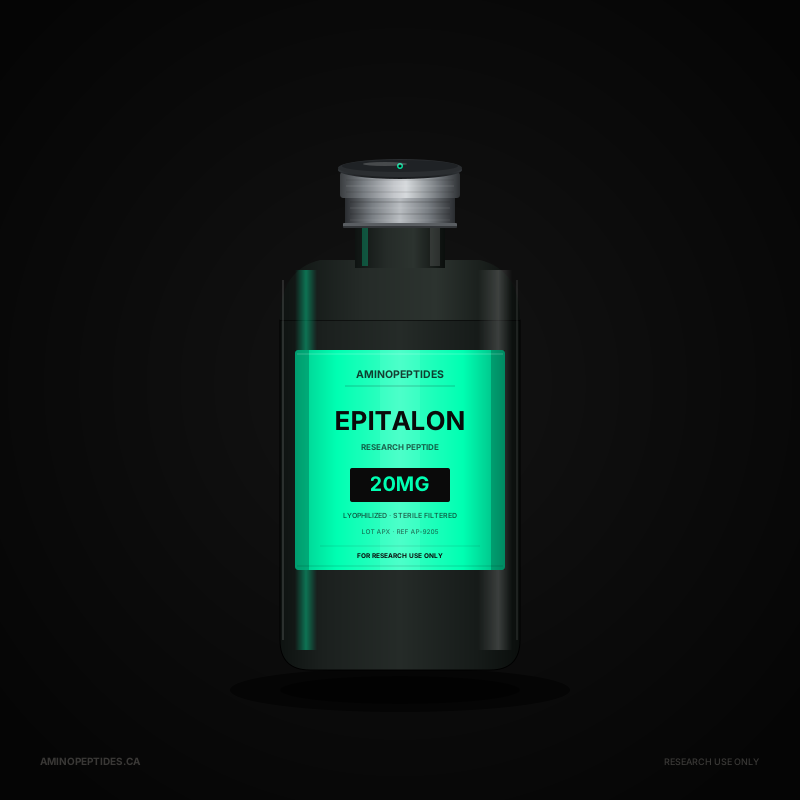
Epithalon (Ala-Glu-Asp-Gly) is a synthetic tetrapeptide studied extensively by Vladimir Khavinson and colleagues since the 1990s at the St. Petersburg Institute of Bioregulation and Gerontology. Its proposed mechanism centers on activating telomerase by derepressing the hTERT gene promoter, thereby lengthening telomeres in human somatic cells — a process directly linked to cellular aging and replicative senescence.
Khavinson’s key clinical work includes a long-term observational study on elderly patients in St. Petersburg (published 2003), with cohorts of several hundred, reporting reduced cardiovascular mortality, improved immune markers, and extended median lifespan. Epithalon also stimulates pineal melatonin secretion, potentially restoring age-related circadian rhythm decline — a secondary mechanism that may contribute to its observed effects on sleep quality and hormonal regulation in elderly subjects.
Typical research dose: 10 mg/day subQ for 10 days, repeated every 6 months. View longevity peptides.
2. Thymalin
Thymalin is a polypeptide fraction isolated from thymus tissue that restores age-involuted thymic output, improving immune surveillance and T-cell function. The thymus gland is one of the first organs to undergo age-related involution, and its decline is increasingly recognized as a driver of immunosenescence.
Anisimov, Khavinson, and colleagues published long-term human studies — notably a 6-year follow-up of approximately 266 patients aged 60 and older — showing that combined Thymalin and Epithalon treatment reduced mortality by roughly 2-fold compared to controls, with improvements in immune function markers including T-cell subsets and IL-2 production (published in Biogerontology, 2010). The magnitude and duration of these mortality effects are remarkable, though the studies originate from a single research group and await independent replication.
Typical research dose: 10 mg/day for 10 days, two cycles per year. See Thymalin 10 mg.
3. FOXO4-DRI
FOXO4-DRI is a D-retro-inverso peptide designed to selectively eliminate senescent (“zombie”) cells — making it a targeted senolytic agent. Its mechanism is precisely characterized: in senescent cells, the transcription factor FOXO4 sequesters the tumor suppressor p53 in PML nuclear bodies, preventing p53 from triggering apoptosis. FOXO4-DRI competitively disrupts this FOXO4-p53 interaction, releasing p53 to activate the intrinsic apoptosis pathway selectively in senescent cells while sparing healthy cells.
In the landmark study by Baar et al. (Cell, 2017), FOXO4-DRI was administered to both fast-aging XpdTTD/TTD mice and naturally aged mice. Results showed restored fur density, improved renal function, and increased fitness metrics with no significant off-target toxicity. The selectivity of the mechanism — exploiting a survival dependency unique to senescent cells — makes FOXO4-DRI one of the most mechanistically elegant longevity peptides identified to date.
4. Pinealon
Pinealon is a short tripeptide (glutamic acid – aspartic acid – arginine) from the Khavinson bioregulator peptide family, targeting the pineal gland and central nervous system. Preclinical data suggest it can penetrate cell membranes and interact with DNA regulatory regions, promoting neuroprotective gene expression through epigenetic mechanisms including upregulation of SIRT1 and modulation of histone acetylation.
Animal studies show improved cognitive retention in aged rats and reduced oxidative stress markers in cortical neurons. While the evidence base is thinner than for peptides ranked higher on this list, the mechanism is well-characterized at the molecular level.
Typical research dose: 100–200 mcg/day. See Pinealon 10 mg.
5. SS-31 (Elamipretide)
SS-31 is a mitochondria-targeted tetrapeptide (D-Arg-Dmt-Lys-Phe-NH2) that binds cardiolipin on the inner mitochondrial membrane, stabilizing cristae structure and optimizing electron-transport-chain supercomplex assembly (particularly Complex III/IV). Since mitochondrial dysfunction is considered a primary hallmark of aging, a peptide that directly restores mitochondrial efficiency has obvious longevity relevance.
Human clinical data is more advanced than most peptides on this list. The TAZPOWER Phase 2 trial in Barth syndrome (approximately 12 patients) showed improved 6-minute walk distance and stroke volume. A Phase 2 trial in heart failure with reduced ejection fraction (~36 patients) showed trends toward improved left ventricular volumes, though the larger PROGRESS-HF trial missed its primary endpoint. The FDA has granted Fast Track designation for Barth syndrome. Browse SS-31.
6. GHK-Cu (Copper Tripeptide)
GHK-Cu is a naturally occurring copper-binding tripeptide (glycyl-L-histidyl-L-lysine) studied extensively by Loren Pickart and colleagues. What sets GHK-Cu apart is the breadth of its gene-expression effects: analysis using the Broad Institute’s Gene Connectivity Map (2012–2014) revealed that GHK-Cu modulates expression of approximately 32% of the human genome, with a signature that reverses age-associated gene expression patterns.
Specifically, GHK-Cu upregulates DNA repair genes, antioxidant genes (including TPA and SOD), and collagen synthesis while downregulating inflammatory and fibrotic gene programs. In skin research, it promotes hair follicle activation, wound healing, and dermal remodeling. The sheer scale of its transcriptomic effects suggests a role as a systemic age-reversal signal rather than a single-pathway intervention.
7. Humanin
Humanin is a 24-amino-acid mitochondrial-derived peptide (MDP) encoded in the 16S rRNA region of mitochondrial DNA. It activates STAT3 signaling and AMPK pathways, with demonstrated effects on insulin sensitivity (reduced hepatic glucose output in rodent models) and neuroprotection against amyloid-beta toxicity — the context in which it was originally discovered.
Circulating humanin levels decline dramatically with age, and human cohort studies have shown that higher circulating humanin is associated with lower HOMA-IR (a measure of insulin resistance) and improved metabolic health. Restoring humanin levels in aged mice improves both insulin sensitivity and cognition, suggesting it functions as an endogenous longevity signal from the mitochondria.
8. MOTS-c
MOTS-c is a 16-amino-acid mitochondrial-derived peptide encoded in the 12S rRNA region. It functions as an exercise mimetic, activating AMPK and regulating folate-methionine cycle metabolism. Lee et al. (Cell Metabolism, 2015) demonstrated that MOTS-c prevented both age-dependent and high-fat-diet-induced insulin resistance in mice.
Subsequent work (Lee et al., 2019) showed that MOTS-c translocates to the nucleus under metabolic stress, directly regulating adaptive gene expression — making it one of the few known mitochondrial peptides that signals bidirectionally between mitochondria and nuclear DNA. Human data is emerging, with early studies linking circulating MOTS-c levels to exercise capacity and metabolic health.
9. BPC-157
BPC-157 is not a “longevity peptide” in the classical sense, but its vascular and GI repair effects restore systems that fail early in aging. Its mechanism centers on promoting angiogenesis via VEGF upregulation, modulating the NO system for endothelial repair, and accelerating collateral vessel formation. These vascular effects are directly relevant to age-related cardiovascular decline.
BPC-157 has the broadest preclinical evidence base of any peptide on this list, with demonstrated effects across tendon, muscle, gut, liver, and nerve injury models. Its unique stability in gastric acid (pH 1–2) and oral bioactivity make it exceptionally practical for research protocols. See BPC-157 5 mg.
10. Cerebrolysin
Cerebrolysin is a porcine brain-derived mixture of low-molecular-weight peptides and amino acids containing neurotrophic factors with BDNF-like and CNTF-like activity. Unlike the single-molecule peptides above, Cerebrolysin is a complex mixture — but its clinical evidence is arguably the strongest on this list.
The CASTA trial (n=1,070) in acute ischemic stroke showed improved NIH Stroke Scale scores at 90 days. Multiple TBI trials (cumulative n > 500) demonstrate improved cognitive outcomes on the Glasgow Outcome Scale. Cerebrolysin is approved in approximately 40 countries for neurological indications, though it lacks FDA approval. Cochrane reviews note moderate-quality evidence for its neuroprotective and neuroregenerative effects.
What This Longevity Peptides List Does Not Include
These longevity peptides were selected based on peer-reviewed evidence. Compounds without sufficient published data were excluded from this longevity peptides ranking.
Several peptides were considered but excluded due to insufficient evidence: thymosin alpha-1 (strong immune data but limited longevity-specific endpoints), AOD9604 (metabolic effects without lifespan data), and various growth-hormone-releasing peptides (which affect aging biomarkers but lack direct longevity evidence). This list will be updated as new clinical data emerges.
Where to Source Longevity Peptides in Canada
All of the longevity peptides featured in this guide are available at Aminopeptides.ca with third-party purity verification and Canadian shipping.
Aminopeptides.ca stocks research-grade versions of most peptides on this list. Every lot ships with ≥ 99.9% HPLC purity and a third-party Certificate of Analysis. Browse our longevity peptides collection.