Table of Contents
Understanding GLP-1 Receptor Agonist Peptides
The semaglutide vs tirzepatide debate has placed glucagon-like peptide-1 (GLP-1) receptor agonists at the forefront of metabolic peptide research. Originally studied for their role in glucose homeostasis and insulin secretion, these compounds have attracted enormous attention from researchers investigating body-weight regulation, appetite signalling, and metabolic syndrome.
For Canadian researchers sourcing reference standards, understanding the semaglutide vs tirzepatide differences is essential for designing effective protocols. This guide compares the three most commonly studied GLP-1 receptor agonists available at Aminopeptides.ca: Semaglutide, Tirzepatide, and Retatrutide.
Semaglutide vs Tirzepatide: Starting with the GLP-1 Benchmark
Semaglutide is a GLP-1 receptor agonist that closely mimics the endogenous incretin hormone GLP-1, with key structural modifications that extend its half-life dramatically. By incorporating a C-18 fatty acid chain and strategic amino acid substitutions (Aib at position 8, Arg at position 34), semaglutide resists degradation by dipeptidyl peptidase-4 (DPP-4) and binds albumin in circulation, achieving a half-life of approximately 165 hours (~7 days) suitable for once-weekly administration. In any semaglutide vs tirzepatide evaluation, this pharmacokinetic profile serves as the baseline.
Key Research Highlights
The STEP trial program (Semaglutide Treatment Effect in People with obesity) established semaglutide as the benchmark GLP-1 agonist for weight research. STEP-1 (n=1,961) demonstrated mean weight loss of approximately 14.9% at the 2.4 mg dose over 68 weeks. Semaglutide’s mechanism centres on activating GLP-1 receptors in the pancreas (enhancing glucose-dependent insulin secretion), the gut (slowing gastric emptying by 10–20%), and the central nervous system (modulating appetite signalling in the hypothalamus and reward centres).
Cardiovascular Evidence: The SELECT Trial
The landmark SELECT trial (n=17,604) studied semaglutide 2.4 mg in participants with established cardiovascular disease but without diabetes. Results showed a 20% reduction in major adverse cardiovascular events (MACE) compared to placebo (HR 0.80, 95% CI 0.72–0.90). This made semaglutide the first anti-obesity agent to demonstrate direct cardiovascular benefit in a dedicated outcomes trial — a finding with significant implications for metabolic research.
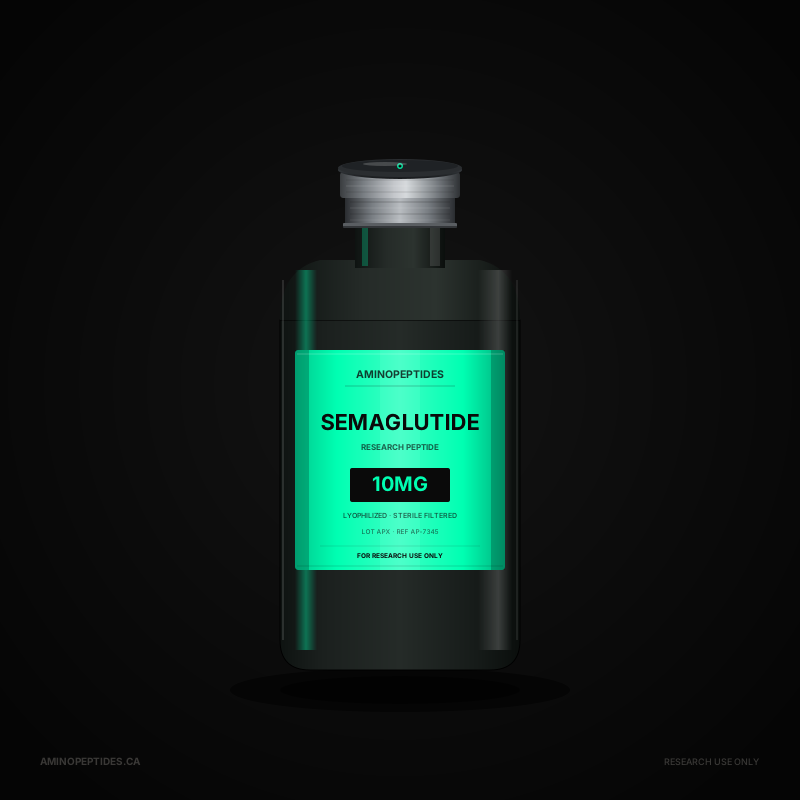
Aminopeptides.ca offers semaglutide in two sizes: 5 mg and 10 mg vials.
Tirzepatide in the Semaglutide vs Tirzepatide Debate
Tirzepatide represents a significant evolution in incretin-based research. Rather than targeting only the GLP-1 receptor, tirzepatide is a dual agonist that activates both the GLP-1 and glucose-dependent insulinotropic polypeptide (GIP) receptors. A C20 fatty diacid moiety conjugated at lysine-20 enables albumin binding and extends the half-life to approximately 5 days. Tirzepatide has comparable affinity to native GIP at the GIP receptor but roughly 5-fold lower affinity for GLP-1R compared to native GLP-1 — yet the dual mechanism produces additive metabolic effects.
Key Research Highlights
The SURMOUNT-1 trial (n=2,539, non-diabetic adults) demonstrated mean placebo-adjusted weight loss of 15% (5 mg), 19.5% (10 mg), and 20.9% (15 mg) at 72 weeks — the largest weight-loss effect reported for any single-agent intervention at time of publication. Over one-third of participants in the 15 mg group lost more than 25% of body weight. In head-to-head comparison (SURPASS-2), tirzepatide 15 mg achieved superior HbA1c reduction (~2.5% vs ~1.9%) and greater weight loss (~12.4 kg vs ~6.2 kg) compared to semaglutide 1 mg.
The GIP receptor activation contributes to improved lipid metabolism and may enhance energy expenditure through brown-adipose-tissue pathways — an area of active investigation that could explain the incremental weight loss over GLP-1-only agonists.
Tirzepatide is available in 10 mg and 30 mg vials for research programs of varying scale.
Retatrutide: Triple Agonism — The Next Frontier
Retatrutide pushes the incretin concept further still. As a triple agonist, it activates GLP-1, GIP, and glucagon receptors simultaneously. The inclusion of glucagon-receptor agonism is what distinguishes retatrutide from its predecessors — glucagon activation promotes hepatic lipid oxidation, increases energy expenditure through thermogenesis, and may add a metabolic “burn” component absent in semaglutide and tirzepatide.
Key Research Highlights
The Phase 2 trial published by Jastreboff et al. (NEJM, 2023) enrolled 338 participants over 48 weeks and produced the largest weight-loss results reported for any anti-obesity agent: the highest dose (12 mg) achieved mean 24.2% body weight loss, with 26% of participants losing over 30% of body weight. Results were dose-dependent across the range: 1 mg yielded ~8%, 4 mg ~17%, 8 mg ~22%, and 12 mg ~24%.
Researchers are particularly interested in retatrutide’s potential effects on metabolic-associated steatotic liver disease (MASLD/MASH) through its glucagon-receptor activity, which directly promotes hepatic fat oxidation. Phase 3 trials are underway and expected to report in 2025–2026.
Retatrutide is available as a 10 mg vial.
Semaglutide vs Tirzepatide: Pharmacokinetic Comparison
| Parameter | Semaglutide | Tirzepatide | Retatrutide |
|---|---|---|---|
| Receptor targets | GLP-1 | GLP-1 + GIP | GLP-1 + GIP + Glucagon |
| Half-life | ~165 hours (~7 days) | ~5 days (114–120 hr) | ~6 days |
| Dosing frequency | Once weekly | Once weekly | Once weekly |
| Half-life mechanism | C18 fatty acid → albumin binding | C20 fatty diacid → albumin binding | Fatty acid acylation → albumin binding |
| Maximum studied dose | 2.4 mg/week | 15 mg/week | 12 mg/week |
| Peak weight loss (trials) | ~14.9% (STEP-1) | ~20.9% (SURMOUNT-1) | ~24.2% (Phase 2) |
| Research maturity | Extensive (large-scale Phase 3, CV outcomes) | Substantial (Phase 3 published) | Emerging (Phase 2 published, Phase 3 underway) |
| Available sizes | 5 mg, 10 mg | 10 mg, 30 mg | 10 mg |
Semaglutide vs Tirzepatide: Beyond Weight Loss
The GLP-1 agonist class is rapidly expanding beyond obesity and diabetes research into several new therapeutic areas:
- MASH/NASH (metabolic-associated steatohepatitis): Tirzepatide’s SYNERGY-NASH trial showed MASH resolution without fibrosis worsening in 44–62% of treated patients. Retatrutide’s glucagon-receptor component may offer additional liver-fat-reduction benefits through direct hepatic lipid oxidation.
- Cardiovascular outcomes: Semaglutide’s SELECT trial established a 20% MACE reduction. Cardiovascular outcome trials for tirzepatide and retatrutide are in progress.
- Obstructive sleep apnea: SURMOUNT-OSA demonstrated significant reductions in apnea-hypopnea index (~25–30 events/hour) with tirzepatide, suggesting weight-dependent improvements in sleep-disordered breathing.
- Heart failure (HFpEF): The SUMMIT trial showed tirzepatide improved heart failure composite scores in HFpEF patients with obesity.
- Kidney outcomes: The FLOW trial demonstrated semaglutide reduced kidney disease progression in patients with type 2 diabetes and chronic kidney disease.
Complementary Research Compounds
When evaluating semaglutide vs tirzepatide for a research protocol, consider these complementary compounds that may enhance study design:
Researchers studying metabolic pathways often investigate GLP-1 agonists alongside other compounds that target weight regulation through different mechanisms:
- AOD-9604 — A modified fragment of human growth hormone studied for its lipolytic properties without the growth-promoting effects of full-length hGH.
- 5-Amino-1MQ — A small-molecule NNMT inhibitor researched for its potential to increase cellular energy expenditure and NAD+ levels.
- MOTS-c — A mitochondrial-derived peptide studied for its role as an exercise mimetic via AMPK activation.
Reconstitution and Research Protocols
All GLP-1 peptides from Aminopeptides.ca ship as lyophilized powders requiring reconstitution with bacteriostatic water. GLP-1 peptides may be reconstituted at higher concentrations (using 1 mL rather than 2 mL of diluent) for dosing convenience at higher dose levels. Direct the solvent stream against the vial wall, swirl gently — never shake or vortex. Once reconstituted, store at 2–8°C and use within 28 days.
Use our peptide dosage calculator to determine exact draw volumes for your target concentration.
Quality and Sourcing
Whether your semaglutide vs tirzepatide comparison study requires milligram or multi-vial quantities, quality sourcing is critical.
Every GLP-1 peptide we ship meets ≥99.9% HPLC purity and includes a third-party Certificate of Analysis with mass-spectrometry confirmation. All orders ship from a Canadian facility with domestic tracking — no customs delays, no border holds. See our purity testing guide to understand what each field on a CoA means.
Disclaimer
This semaglutide vs tirzepatide comparison is for educational and research purposes only.
All products sold on Aminopeptides.ca are research-grade reference standards for laboratory research purposes only. These compounds are not drugs, supplements, or approved for human or veterinary use. Researchers must comply with all applicable regulations.